Sunday, March 18, 2012

Module VI - American Period: Transportation and Communication

Essential Question:
*Alaska's infrastructure of transportation and communication systems- what are the cause-effect relationships to settlement patterns and to the development of the Alaska economy?


Transportation and communication systems in Alaska were greatly affected by economics as well as technological developments. Let's look at the current transportation and communication systems to see how they have evolved over time to become what they are today.

Ocean and River Transportation:
Most early settlements in Alaska were located on the coast and near large rivers that
could be accessed by boats. These waterway routes had been used for centuries by Natives and later by Russians and Europeans. Although waterway routes had been heavily used throughout history, traveling these routes in Alaska proved dangerous. It took time for surveyors to chart the waters surrounding Alaska but this did not impede economic pursuits. Early economic booms brought hoards of adventurous souls looking for gold, creating a great demand for passage north. The earliest route north was via waterway routes. Other industries drove the use of water transportation as well. Commercial fishing provided demand for suitable employees as well as transport of processed fish bound for markets.

Over time, technology has made passage in Alaska waters easier, faster, safer, more comfortable, and affordable. The Alaska Marine Highway provides extensive waterway transport throughout Alaskan cities and towns. Also, many private shipping and commuter companies service the area. Today tourism relies on the beautiful marine transportation system in the state. Because of advanced technology, new means of transport through the unforgiving territory of the state makes marine travel just one of many modes of transportation.
Marine transportation: flickr.com

Air Transportation:
Technological advances created opportunities for people to do the unthinkable - fly. Challenges presented by the treacherous topography of Alaska made flying the most practical mode of transportation. Not only did flying avoid impassable obstacles, it was faster. This opened up the state to new opportunities but also impacted travel methods of old. Flying contributed to the closure of the steamship transport on the Yukon River. It is interesting to observe the cause and effect relationships of transportation methods.

Alaska Airlines: flickr.com
A growing need for air transportation created industry. Because of aviation, schools were formed to provide opportunities for those seeking employment in aviation. Due to an increasing demand on air travel, many airfields were built and, over time, many flights were scheduled to and from Alaska, thus stimulating economy. It took time but Alaska and it's citizens benefited greatly from the development of air transportation. Currently, many communities rely heavily on air transport of mail, goods, and services. Air travel remains to this day the most efficient way to travel great distances in the state.

Road and Rail Transportation:
Rail transportation was primarily developed because of the gold rush and mining industries. The railroads were used to transport people to work in the mines as well as to transport the ore that would be mined. Railroads not only provided a mode of transportation, they created an industry that developed opportunities to those looking for employment. The building of Alaskan railroads required many trained engineers as well as laborers. This provided jobs for people in the state of Alaska.

Many different railway endeavors were pursued but few were met with success. The railroad endeavors that were completed were short lived and faced ongoing challenges. One rail company that is still around today is the Alaska Railroad. During World War II the Alaska Railroad was used heavily to haul military supplies into Interior Alaska. After the war, the railroad equipment was in need of repair. Military construction in the 50's and oil pipeline construction in the 70's kept the Alaska Railroad running. In 1985 the State of Alaska purchased the Alaska Railroad. It is still in operation today transporting over 6.1 million tons of cargo in 2008 and is now connected with the Alaska Rail-Marine Service that ports in Seattle and transports rail cars to and from the lower 48. Alaska Railroad also attracts tourists. Currently, other modes of transportation compete with the slower, less reliable rail system, making it less profitable than in times past.

Communication Systems:

Alaska was heavily dependent on communications systems because of the fact that communities were far spread. The communication systems in Alaska began first as simple operations. Early in the 1900's, mail arrived via dog team, river steamer, or aboard ships. As transportation methods improved, so did the communications system, creating a cause/effect relationship.

The US Postal Service was one of the first communication systems, beginning in the late 1800's. The service was provided in specific areas and would expand as transportation methods improved. Airmail began in the 1920's as one military plane was used to fly mail between Fairbanks and McGrath. Certain regions of the state received little or no mail during certain parts of the year due to accessibility issues. Eventually

The US Army played a large roll in the development of early communication systems. Technological discoveries
such as the telegraph, WAMCATS, satellites, long-distance phone service, and telecommunications eventually changed the connections that the citizens of Alaska had with other communities.

Examine Question:

*What is the current status of ocean and river transportation in Alaska? How significant is it today?
Many people do not realized that today, over 80% of all Alaska's cargo arrives via marine transport. In the 1990's nearly 90% of cargo arrived by water. I believe the reason for decline is because of an increased dependence on air transportation for cargo. Many airplanes are now responsible for moving mail and freight between Alaska ports and other countries and states. But, we still rely heavily on marine transportation in Alaska today. River transportation, on the other hand, is not what it was in the past. Because of air transportation it is much easier and faster to travel or send freight. This eventually made the steamships obsolete, as they could not compete with air travel. This being said, we still rely heavily on marine transportation in this state.

Extend:

What/why are the rail/road connections in the area of Alaska where you live?
I am located on Prince of W
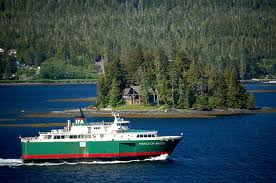
ales Island. Due to location, there is no railroad service on our island. We rely heavily on the Inter-Island Ferry Authority - IFA for short- for passage into Ketchikan. From here we hop aboard the Alaska Marine Highway or an Alaska Airlines flight that will take us anywhere we would like to travel. Air travel is also accessible to and from the island.


Interisland Ferry Authority: evergreenfleet.com


Unlike many Southeast Alaskan communities, Prince of Wales has over 2,000 miles of roads. These roads are the results of the logging industry on the island. The roads make much of the island accessible to citizens and tourists but is used little for mass transport of goods.

Evaluate:
I continue to struggle with knowing the information well after spending much time on reading and blogging format issues. Everything is taking longer than I thought. When I find myself out of time I tend to publish what I would call a less than perfect posting, where I am leaving out information. The reading is always interesting but takes me a while to really grasp all of the content.

Colleague Reviews for Module V:


Exploring Alaska's Cultures
Shannon shared a great link that lead me to read more about the Bokan Mountain Mine Project on Prince of Wales Island, just south of where I am living currently.

Latitude 61
Crystal used many links that lead to other informative publications. This gave me some ideas on how I can improve my blog in the future. She also did a great job elaborating on mining and how it has impacted the state of Alaska.

Crossing Alaska
I enjoyed Kristi's summary of the components of the economy as well as her insight on the purchase of Alaska. She also included some interesting facts on the purchase of the Virgin Islands.


Sunday, March 11, 2012

Module V - American Period: Alaska's Economy

Essential Question:

What have been the major components of the Alaska economy during the American period of 1867-present?

Since the discovery and purchase of Alaska, the state has witnessed several changes in what components drive the economy. Early in Alaska's history, fur trade, fishing and whaling, mining and mineral development, logging, and agricultural endeavors were the driving forces in economy. Later, tourism was added as a piece of the Alaskan economy. As a result of reading the Alaska History and Cultural Studies text over the past week, it is apparent that the advancements in technology and an awareness of over-harvesting has changed the economy in the state of Alaska in the past 50-60 years. Let's take a brief look at the components of the Alaskan economy over the past 140 years.

Mining and Mineral Development -

The first search for mineral resources was conducted by the Russians as they searched for coal. Later, the search for gold began in Alaska in the late 1800's in and around the areas of Sitka and Juneau. Many precious metals were found in various sites throughout the state. Early mining was limited in production because of tool availability. Because of the advanced tools available, mining is now conducted on a much larger scale today. Several mines are currently in operation around the state, contributing to the economy of the Alaska.

The impact of oil development in Alaska has had lasting and far reaching affects. What began as a small discovery in the 1900's, oil now contributes around 88% of the state's revenue, providing jobs for 1/3 of the state's residents. Oil is the natural resource that took Alaska from one of the poorest states in the nation to one of the wealthiest.
Trans-Alaska Oil Pipeline
Fotopedia.com
Fur Trade-
Early in the history of the Alaska territory, fur trade was the dominant economic activity. Each year thousands of fur-bearing animals were killed and processed for their fur. These activities were conducted with no restrictions on species and numbers harvested. Over time, traders realized that the resources were dwindling in numbers. When the numbers of the fur-bearing animals declined, those who depended on fur trade for income suffered.

In the 1920's
the federal government became involved in conserving the fur-bearing animals. The Alaska Game Commission was formed to regulate the numbers being harvested and the methods of harvest. Many special regulations were created to help the Natives continue to live the subsistence lifestyle that had supported them for centuries. After Alaska became a state in 1959 all management of fur-bearing animals was turned over to the Alaska Department of Fish and Game.

Currently, some citizens harvest fur-bearing animals for income. It is a small enterprise with very few people in the state solely dependent upon fur-trade as income.


Fishing and Whaling
-


Commercial fishing in Alaska began before 1867, cod being the species targeted. Over time, other species were harvested. Salmon, halibut, herring, shrimp, and crab were targeted as money makers. Commercial fishing created a need for processing plants or canneries which created jobs throughout the state. The increase in available jobs brought immigrants from various countries for the seasonal jobs available. Eventually, because of overfishing, fish numbers declined. Therefore, the fishing industry experienced fluctuating successes and failures due to resource availability.

Whaling was very profitable in the late 1800's and early 1900's. Technology advancements made it possible for whalers to harvest large numbers of whales. Eventually whaling suffered much like the other economic sectors because of the over-harvest of the resource. Those in search for whales turned their interest to walruses. Over time, walrus numbers declined as well. Due to decreasing numbers, whaling and walrus hunting became highly regulated or eliminated altogether.


Commercial Halibut Vessel
Public Domain


Logging-


Because of the growth in the fishing and mining industries, the demand for lumber increased. Another opportunity to make money presented itself. Lumber mills began to develop in order to meet the needs of the growing industries in the state. Logging has contributed to the economy of Alaska, and is still prevalent throughout the state. Due to conservation efforts, logging is highly regulated, creating a limited supply and preserving the resource for the future.

Agricultural Endeavors-

Many agricultural endeavors were attempted in Alaska in the past 140 year. Many of these attempts were the result of the need for food of citizens in the state. Many attempted to farm crops that would help sustain the growth and development throughout the state. Also, attempts were made at raising cattle, sheep, fox, and reindeer. Several attempts ended in failure. It was discovered that certain regions of the state could sustain these endeavors but few resulted in significant economic contributions.

Tourism-


Tours of Alaska became available in the ate 1800's. These vacations were very expensive, resulting in few visitors. A boom in tourism occurred after World War II. The development of the Alaska Railroad, the Alaska Marine Highway, and the Alcan highway created more opportunities for tourists to visit the state. Today, tourism creates many seasonal jobs and brings many tourists with wallets of money to spend in the Alaska.

Examine Question:

What has been, over time, the pattern of development for Alaska's fur trapping and trading, commercial sealing, whaling, and fishing?

It is obvious that fur trapping, sealing, whaling, and fishing were heavily impacted by over-harvesting in the early years of the industries. In the early years, trapping and trading were leading in economic importance in the state.
Large amounts of money was made during large harvest years. Although much money was made in the industry, the resource availability was unpredictable, causing trouble for Natives and others who depended on the fur market.

Because of over-harvesting numbers dwindled, thus impacting the availability of resources in the following years. Results of the mass slaughters were devastating to the industry. Regulations were imposed on
fur trapping, sealing, whaling, and fishing. The need to protect these animals from extinction eliminated this market altogether.

Extend:

What is the economic base for your area of Alaska? Also, share any current issues confronting the local residents.

The economy on Prince of Wales island is driven by logging and commercial fishing. Prince of Wales island is home to the first American shore-based saltery in the state which is located in Klawock. Many relics of the past exist due to the fact that the fishing industry is not what it was in the past. That being said, the industry does continue to provide some economic stimuli. Logging is also an economic pursuit. Although highly regulated and restricted, jobs are still created because of the industry.


Evaluate:

Again, a busy week with much information to cover. I found the information quite intriguing. It is taking me much time to cover the information. I still struggle with formatting and getting images for my blog. I find it especially frustrating to cite where images come from. I will be working on that over the week.

Colleague Reviews for Module IV:

Gary's Alaska Blog
I enjoyed Gary's summary of Russian America. I also thought he had great pictures as well.

Robin's Surveying Alaska History
I felt that Robin had great insights on the Russian Orthodox church. I also connected with her as she is struggling with photos and captions on her blog.


Heather's Alaska Exploration
Heather also presented a great summary of Russian America. Her layout, pictures, and cited resources were fantastic.


Sunday, March 4, 2012

Module IV - Russian America

Essential Question:

What was the nature of cultural contact between the Europeans of Russian America and the Natives of Alaska?

The Europeans of Russia began exploring the areas of Alaska having lasting impacts on the region. It is interesting to examine and explore the history of Alaska as we keep in mind cause and effect. It is important to also remember that Russian colonization took place over a period of time and was not one incident or an isolated event. The Europeans of Russian America came to Alaska for several reasons but the main reason was fur. The well kept records of the Russian explorers displays interesting insight of the explorers and their first impressions of the areas and the Native people they encountered.

http://vilda.alaska.edu/u?/cdmg11,11932
Territory ceded to US by Russia - UAF-G4370 1867 U551

The search for fur was the driving force behind Russian colonization. This colonization had a huge impact on the Natives in regions throughout Alaska. The largest impact was the effect of the various diseases that the Russians and other European explorers brought into the regions of Alaska. Many Natives perished because of these illnesses. Their delicate immune systems were not prepared to battle the diseases brought by the explorers.

From what I understand, many people are still being affected in an indirect way because of the Russian influences in Alaska. Because of the fur trade and over-harvesting of sea otters, laws were put into place to protect the species. I have listened to long-time citizens in my area discuss the impacts of these laws. Many now believe that because sea otters are protected they are rebounding with great force. It has been questioned whether the abalone populations have declined immensely because of the large populations of sea otters. Balance is again in question.

Examine Question:

What were the various economic ventures of the Russian America Company?

Fur trade was not the only economic venture of the Russian America Company. Many other business opportunities presented themselves as a result of the fur trade. Another example of cause and effect. Fur trading brought other economic ventures such as ship building, agriculture, hunting, fishing, mining, and manufacturing.


Agriculture became important due to the fact that the explorers needed food to in order to survive. As stated on the Alaska History and Cultural Studies website, the crops that were planted were wheat, barley, peas, beans, turnips, beets, mustard, parsnips, potatoes, and gourds. The first seasons crops were destroyed because of birds, mice, and flooding. It turned out that the best crops to raise in the area were barley, cucumbers, cabbage, potatoes, rutabagas, and turnips. The island of Kodiak also witnessed attempts at cattle raising. At this time it was so difficult to obtain enough food for the cattle to eat over the winters that the efforts were abandoned. It is still possible to see effects of the attempts of the cattle raising today, as wild cattle still roam the island.

Ship building was an industry that began as a result of efforts from Alexander Baranov in 1793 at a location nearby the current area of Seward, Alaska. Local resources were used in the construction of the large ships. These ships became important for the development of the area. They were used to transport goods to and from Russian America. Eventually ships were being purchased from the United States because they lasted longer due to the fact that they were built from harder lumber which led to the disappearance of the industry in Alaska.

Fishing and whaling also helped the progression of settlements. In the beginning fishing and whaling helped sustain the inhabitants of the regions of Alaska but eventually the people were able to harvest enough to begin trading and transporting it back to Russia.

Manufacturing of bricks and ice were other attempts at economic endeavors. Neither lasted long. It was less expensive for bricks to be purchased from Canadian regions and the demand for ice diminished. With no market for either item, production ceased.

A great deal of effort was put into coal mining but proved to be without profit. There were many reasons for the mining attempt failure. It turned out that purchasing coal was less expensive from other sites which effected demand for the coal in Alaska. The decision to close the mine came after a fire damaged the site.

It is apparent that all economic endeavors developed from a legitimate need for goods that would help people prosper in the land. Little physical evidence exists in Alaska from the economic attempts of the Russians.

Evaluate:

Again, I found the content of this weeks module fascinating. I am enjoying learning new things about Alaska that I had not known before. I knew little about the economic endeavors pursued by the Russians in the Alaska territory. My struggle continues to lie in blogging. I am struggling with the format of my blog. I need to spend some time on YouTube trying to figure out how to get web pictures in my blog and have them look appropriate. The blogging is taking me more time than I had anticipated.

Colleague Reviews for Module III

Holly Cervin expressed her concern for the loss of Native culture specifically in the Tlingit culture. I have had discussions with many Natives in my area that express the same concerns and are actively trying to preserve their culture.

Joel Moorman shared some interesting personal experiences that helped me better understand the culture in Toksook Bay.

Joan Walser expressed some interesting insight on what being "Alaskan" means and brought up the question of whether there is a point when a person becomes a true "Alaskan" or is it more of an evolution to "Alaskan". I will keep thinking on the idea.

Sunday, February 26, 2012

Module III - Cultural History


Essential Question:

* Is there an "Alaskan" culture? How could it be described?

In searching for an answer to the question, and as part of our weekly assignment, I spent time trying to understand more clearly what culture is. In my efforts I learned from Wikipedia that culture is a set of shared attitudes, values, goals, and practices that characterizes an institution, organization, or group. With this definition I would say that Alaska is a makeup of many different cultures. For example, during Module III we read about numerous Native groups that inhabit the areas of Alaska and have been here for centuries. Also, African Americans, Asian Americans, European Americans, Polynesians, and Latin Americans have immigrated to Alaska. They all have commonalities and unique differences that shape their dynamic cultures but to say that we have a blanket "Alaskan" culture is limiting.

Not only is there not one specific "Alaskan" culture, it seems that there are many micro-cultures, or cultures within cultures, evident as I examine more closely. I have witnessed many different cultures existing where I live on Prince of Wales Island. All have changed over time and have done so because of the influence of other cultures.

Examine Question:

* In addition to the wave of Euroamericans who came to Alaska, what other groups emigrated to Alaska, and why?

African Americans, Asian Americans, Polynesians, and Latin Americans are some of the immigrants that came to Alaska. The reasons for coming are many. Let's look at one group at a time and examine the motivating factor for their arrival in Alaska.

*African Americans - There were several reasons for African American migration into Alaska. Many came because of military purposes, some came because of the Gold Rush, and early black immigrants came because of fur trade and whale hunting.

*Asian American - The Asians were early immigrants to Alaska, crossing the Bearing land bridge nearly 5000 years ago. The Filipinos were the largest Asian ethnic group to arrive in the area. They came on whale hunting ships, for fur trade, and to work in gold mines. But the majority of the Filipinos that came worked in the canneries.

*Polynesians - The Polynesians, most from the islands of Hawaii, began arriving around the 1700s when Captain Cook was exploring the Pacific. This ethnic group has been the fastest growing ethnic group in Alaska since the 1990s.

*Latin Americans - Spanish explorers came to the Alaska in the 1700s to see what the Russians were doing in the area. Some stayed. Also, many have immigrated to the state in recent years. The Latin Americans are the second largest minority group in the state.

Evaluate
I would have like to have spent more time exploring the materials in this module. Great resources! It was a very busy week for me. The busyness made it really difficult to thoroughly explore all the material and get my blog posted. I continue to have a busy schedule with a couple more days at the ASTE conference. I am learning some cool new technology but have been slammed with busy schedules and lots of cool information.

I love the content of the class and I am still trying to figure out how to create a good blog. Practice makes perfect, right?

Colleague Reviews for Module II


Investigate Alaska
I explored Betty Hanson's Investigate Alaska blog. She did a great job comparing and contrasting Native knowledge and Western science in her blog. Also, I enjoyed reading more about climate change and global warming.

Educational Exploration in AK

I experienced some of the same impressions as Kristin Ratigan as I worked through Module II. I knew very little about the troubles that were being faced in Shishmaref caused by climate change.

Gary's Alaska Blog
Gary put it well when he questioned whether individuals think about the impact of when the "SUV rolls to life". I think education is wonderful in the sense that it helps enlighten us about the impacts that are made globally because of human behaviors. This takes us back to the idea that we are all connected.

Sunday, February 19, 2012

Module 2 - Natural History

Essential Question:
  • How have Alaska's natural systems changed over time?
As we all know, the world we live in is constantly changing. These changes aren't which new restaurant arrived in town or the new stoplight at the corner of A Street and 5th Ave. After enjoying the materials in this module it is now more evident to me than ever that this planet is active and changing constantly. We often see on the news how and where things are changing around the world, for example earthquakes and tsunamis in Japan, volcanic eruptions in Iceland, but Alaska is experiencing a changing at a rapid pace as displayed in the various resources viewed in the module. I will share some information in regard to Southeast Alaska.

One change observed in my area is the habits of whales that people believe may be related to the increasing temperatures of the water. I have asked many life-long residents of Craig, Alaska about the changes they have observed over time. Some answers are directly related to Alaska's natural systems. One observation is in regard to whale migration. From what I understand, the whales in the area typically migrate to warmer waters in the winter to breed and give birth. Locals have observed over time that whale habits have been changing. It is now common to see whales in the area all year long. I can't help but wonder WHY?
Click on the pictures to learn more.

Breaching humpback whale

Picture from www.alaskahumpbacks.org.

Also, because of the temperature increase, residents claim that other species are being impacted as well. One species is the Canadian Goose. I have heard that Canadian Geese migrated through these areas but now are found here year round. Again, you have to ask, what is happening in the natural system that is making this kind of change in behavior? Sometimes we don't have all of the answers but we do have evidence of changes in the natural system.

http://upload.wikimedia.org/wikipedia/commons/4/40/Canada_goose.jpg
Picture taken from Wikipedia.org.


Examine Question:
  • How has Alaska's climate changed over millions of years?
History has shown that change is inevitable. We have learned this through scientific research. Alaska has experience much change over time and is currently experiencing change at accelerated speeds when compared to other regions of the planet. What was Alaska like in the past? Let me share some interesting information I learned from the resources on the module.


I did not realize that at one point in history a sheet of ice thousands of feet thick covered from Alaska to New York. This planet is not the same planet of the past. This is evident in Alaska by researching and observing the glaciers. Learn more about glacial changes by clicking on the picture at the right.


The Warming Trend and the Greenhouse Effect

The extensive research that is being conducted reveals that currently Alaska, as well as the rest of the planet, is heating up. Because Earth is changing, we are learning that there are several negative impacts of the warming. Several examples were exhibited in the module we read. These changes will impact the future of our students. As we have viewed there are many educational resources readily available for classroom use. We can use these resources to help our students gain a global perspective on climate change and how Alaska has changed over millions of years.

Extend:

*How might you use content from this module in your professional practice?

We learned in Module II that changes are occurring to climates on Earth. In my blog I shared information about changing water temperatures in Southeast Alaska. I would like to use some new science tools to help students learn about the changing water temperatures in and around Craig. Recently our technology department purchased some WebQuest sensors that can test temperature as well as the salinity of water. I would like to involve my students in the research of changing water temperatures. I could use many of the videos on Teachers' Domain to help students get a perspective outside of Craig. Looks like some field trips! :)

Evaluate:

The module material took much longer to go through than I had anticipated. I did enjoy it though, as it was very educational and entertaining. I will have to plan more time for the viewing of materials next week.

The blogging is getting easier. It is a cool resource. I can see many useful applications for blogging. I am sure I will learn more about it as I go.

Saturday, February 11, 2012

Module I - Place and Pedagogy

Essential Question:
*How can educators use new media to better reach and teach Alaska's students?

I believe that people are somewhat limited in their ability to understand certain concepts because they often lack concrete experiences directly related to those concepts. We can use new media to better reach and teach students in Alaska by creating concrete experiences. One example I have that has led me to this understanding is observing tidal changes. Before living near the ocean I could explain how tides worked but I didn't truly understand. I could explain how the tides worked. I knew that the water levels would rise and fall in a pattern of time but I didn't really understand what that meant. Through concrete experiences I now understand what it means when people talk about tides. New media can present information that will create concrete experiences, which, in turn, will create a deeper understanding.

The media resources we have at our fingertips can help bridge the gap between knowing and understanding. This coming week our state recognizes Elizabeth Peratrovich for the contributions she made to civil rights for the Natives of Alaska. During my reading I found media resources that I was able to use to bring a piece of our Alaska history to life. I found the movie on the Alaska History and Cultural website. The link is listed below.

http://www.akhistorycourse.org/articles/article.php?artID=418

I have learned and taught many things about civil rights. Much of what I have shared has been about Martin Luther King, Jr., or Rosa Parks and is important to learn and understand but this video clip helped my students connect on a deeper level because this happened here in Alaska, the students' homeland. We now have media accessible to help students gain those connections and concrete experiences that were more difficult to provide before our technological advances.


Examine Question:

*How does the connection between people and place appear in your community?

The people living in my community are very much a product of the Place in which we live. Craig, Alaska is made up of a variety of different people from all over. Many of the people have either family ties that date back centuries, or have been brought here because of what they do for a living. The people here are what they are and do what they do because of Place.

Many people call this Place home. The Natives that have inhabited this land for centuries and are still thriving here, have a deep connection to this Place. Many still live a subsistence lifestyle, meaning they live off of the land and sea. In order to live, they work hard to harvest berries, sea greens, seafood, deer, and other resources. Also, many people here benefit from the abundant fisheries and large spreads of lumber. This occurs because Place. Fishermen and lumber companies would not be successful if the Place was different here.

All people in this Place are connected. Many of us rely on the same resources and it requires a balance of use to sustain resource availability. We must all work together to keep our Place healthy in order to guarantee the availability of resources in the time to come.

Extend:
*Look for ways to share culturally relevant digital resources you may find.

As mentioned earlier, I used media resources I found on Elizabeth Peratrovich in my classroom last week. We are currently preparing to perform at our annual Elizabeth Peratrovich celebration and I wanted students to have a better understanding about who Elizabeth Peratrovich was, and the contributions she made to positively influence the civil rights movement. I am always excited when I find great media resources that will increase understanding of the content we are learning.

Evaluate:
I found the resources in this module interesting and useful. I always enjoy finding resources that I can use immediately in my classroom. I was able to share some of my findings right away. The resources available in this module are now bookmarked on my computer and are just a click away. I am excited to learn more throughout the future modules.

Monday, February 6, 2012

Places I Love

I moved to Southeast Alaska in 2010 from Utah. I have lived in Utah most of my life. It is the world I understand best. It was my Place. The world I knew. But I needed a change. I wanted an adventure. I wanted new experiences. I truly had no idea how different this new world would be.

If you know anything about Utah you probably know that it is a desert. It is hot and dry in the summer, and cold and snowy in the winter. The sun loves to shine in the state of Utah. In Utah we received about the same number of sunny days as Southern Alaska receives rainy days. Utah has a few lakes but nothing that compares to the Pacific Ocean. I didn't even need to know what flotsam was. We didn't have any in the state.

Southeast Alaska is my new world. I want to learn all that I can about this beautiful place. Although this is my new favorite place it reminds me of a story I read recently - Grandfather's Journey by Allen Say. I connect with the message of the story -when I am in one place, I am homesick for the other.